

STRC Volatility Claims Draw Attention Across Asset Classes
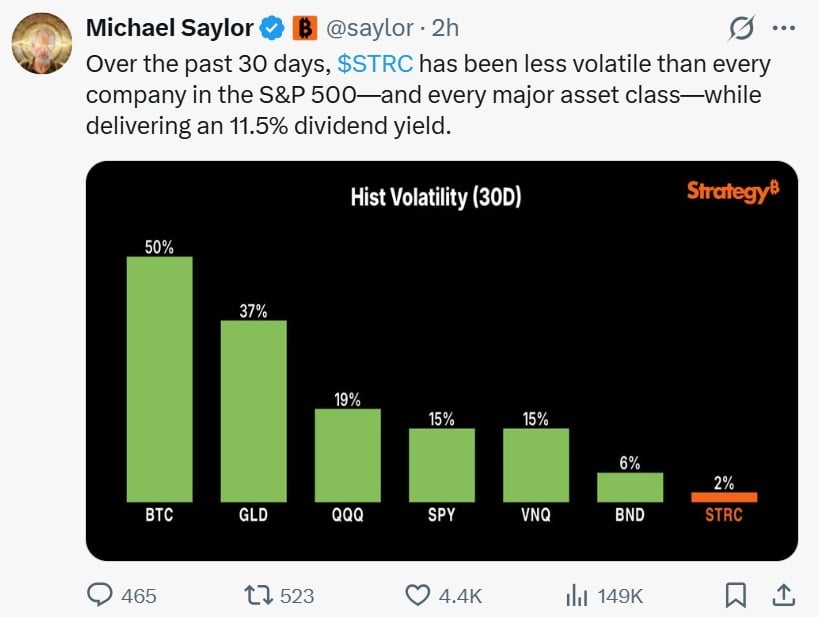
Market volatility disparities across major asset classes came into focus after Strategy Executive Chairman Michael Saylor shared comparative data on X on March 29. The figures positioned STRC, a preferred equity instrument, against bitcoin, exchange-traded funds, commodities, and bonds over a 30-day period.
Saylor stated that over the past 30 days, STRC recorded lower volatility than every company in the S&P 500 and all major asset classes while delivering an 11.5% dividend yield. The dataset showed STRC at 2% volatility, compared with bitcoin at 50%; gold at 37%; QQQ, an ETF tracking the Nasdaq-100, at 19%; SPY, an S&P 500 ETF, and VNQ, a real estate ETF, both at 15%; and BND, a total bond market ETF, at 6%, with bitcoin ranking as the highest- volatility asset.
STRC, or Short Duration High Yield Credit Stretch, is a perpetual preferred stock issued by Strategy Inc. and introduced in July 2025 as part of its bitcoin-focused treasury model. The Nasdaq-listed instrument pays an 11.50% annual dividend distributed monthly in cash, with its rate adjusted each month to encourage trading around its $100 par value and reduce price volatility.
Dividend Mechanics and Risk Debate Intensify Scrutiny
The design of the instrument centers on a variable dividend mechanism that increases payouts when the share price falls below $100 and reduces them when it rises above that level, creating incentives for price reversion. This monthly reset structure differentiates it from traditional preferred shares and is intended to suppress short-term volatility while maintaining consistent income.
The structure within Strategy Inc.’s capital stack places STRC alongside multiple securities offering different risk exposures, including MSTR common stock, which absorbs bitcoin volatility, and preferred instruments such as STRF, the 10.00% Series A “Strife” Preferred; STRK, the 8.00% Series A “Strike” Preferred; and STRD, the 10.00% Series A “Stride” Preferred, each providing fixed or convertible yields with varying seniority. STRC is the only instrument in the lineup explicitly engineered to minimize volatility through active dividend adjustments.
Criticism has centered on whether the reported stability reflects underlying market conditions or issuer-driven mechanisms, with analysts arguing the comparison spans fundamentally different asset types. Observers note STRC functions more like a short-duration credit instrument than a freely traded asset, with its stability tied to dividend incentives rather than organic price discovery, while additional concerns focus on dividend sustainability, funding sources, and issuer-specific risk, including exposure to a single corporate entity and tail risk not reflected in short-term volatility metrics.
FAQ 🧭
- Why is STRC showing lower volatility than other assets?
Its variable dividend mechanism incentivizes price stability around a fixed par value. - What makes STRC different from bitcoin or ETFs?
It behaves like a structured credit instrument rather than a freely traded market asset. - Is the 11.5% dividend yield sustainable?
That depends on Strategy’s capital strategy and ability to maintain payouts over time. - What risks should investors consider with STRC?
Exposure to a single issuer and reliance on engineered pricing mechanisms create unique risks.