
New changes are coming to the crypto space, with the most talked-about trend being the tokenization of real-world assets. Centrifuge (CFG) is at the center of this shift, bridging traditional and decentralized finance by bringing real-world assets such as invoices, real estate, and credit portfolios onto the blockchain.
In this Centrifuge review, we’ll explore how the protocol works, the role of the CFG token, and its potential in the growing RWA-DeFi market.
What Is Centrifuge (CFG)?
Centrifuge (CFG) is a decentralized asset financing protocol designed to bring real-world assets such as invoices, real estate, and credit portfolios onto the blockchain. Instead of relying on traditional finance rails, Centrifuge bridges traditional finance and decentralized finance by turning tokenized real-world assets into investable opportunities.
The protocol enables asset originators to access liquidity while giving liquidity investors exposure to stable yield backed by valuable real-world assets.
Centrifuge runs on its EVM-native Layer 1 chain with multi-chain support, using oracles for data verification and NFTs for asset representation. The chain also uses the centrifuge token (CFG) to power governance voting, staking, and paying transaction fees within the ecosystem.
Who Created Centrifuge?
Centrifuge was founded in 2017 by Lucas Vogelsang, Martin Quensel, and Bhaji Illuminati, a team with backgrounds in fintech, software, and traditional business lending. The Centrifuge team created Centrifuge to connect businesses and investors. Instead of relying on a large financial institution or a wealthy private investor, the protocol allows asset originator businesses to tap into global capital markets.
The Problem Centrifuge Is Solving
Small businesses rarely get fair access to financing. Traditional finance, which offers loans, is slow, expensive, and heavily dependent on intermediaries. Meanwhile, in crypto markets, capital often circulates within the decentralized finance ecosystem without touching the real economy.
Centrifuge work focuses on fixing that disconnect by bringing real-world assets onto the blockchain. By leveraging real-world asset tokenization, businesses can use off-chain assets as collateral to secure additional working capital. Instead of going through banks, asset originators can collect assets, structure them into asset pools, and offer them to liquidity investors.
How Does Centrifuge Work?
Centrifuge protocol takes off-chain assets, like invoices or credit lines, and brings them onto the blockchain as tokenized real-world assets. These are grouped into asset pools, where different types of investors can step in and provide capital.
Businesses
For businesses, Centrifuge acts as an alternative to traditional business lending methods. Instead of going through a large financial institution, asset originators (i.e., the businesses or lenders themselves) upload and verify real-world assets, such as invoices, mortgages, or supply chain financing agreements. These become verified real-world assets with ownership verifiable both off-chain and on-chain.
Once validated, these assets are bundled into asset pools using Centrifuge’s core product, Tinlake. This is where businesses’ Tinlake interactions take place; they structure deals, define risk parameters, and open them for funding. This setup enables businesses to access liquidity faster, gain additional working capital, and unlock working capital solutions without relying on banks.
Investors
On the investor side, Centrifuge offers exposure to tokenized real-world assets that behave differently from typical crypto assets. Investors deposit stablecoins into asset pools, where funds are deposited within Tinlake pools and allocated across two main tranches:
- DROP tokens (lower risk, senior tranche investments)
- TIN tokens (higher risk, junior tranche)
DROP tokens provide more predictable returns, often tied to accrued interest from underlying loans. These are designed for investors looking for a stable yield, similar to fixed-income products in traditional finance. Meanwhile, TIN holders, sometimes referred to as frontline TIN holders, take on first-loss risk.
Centrifuge Prime
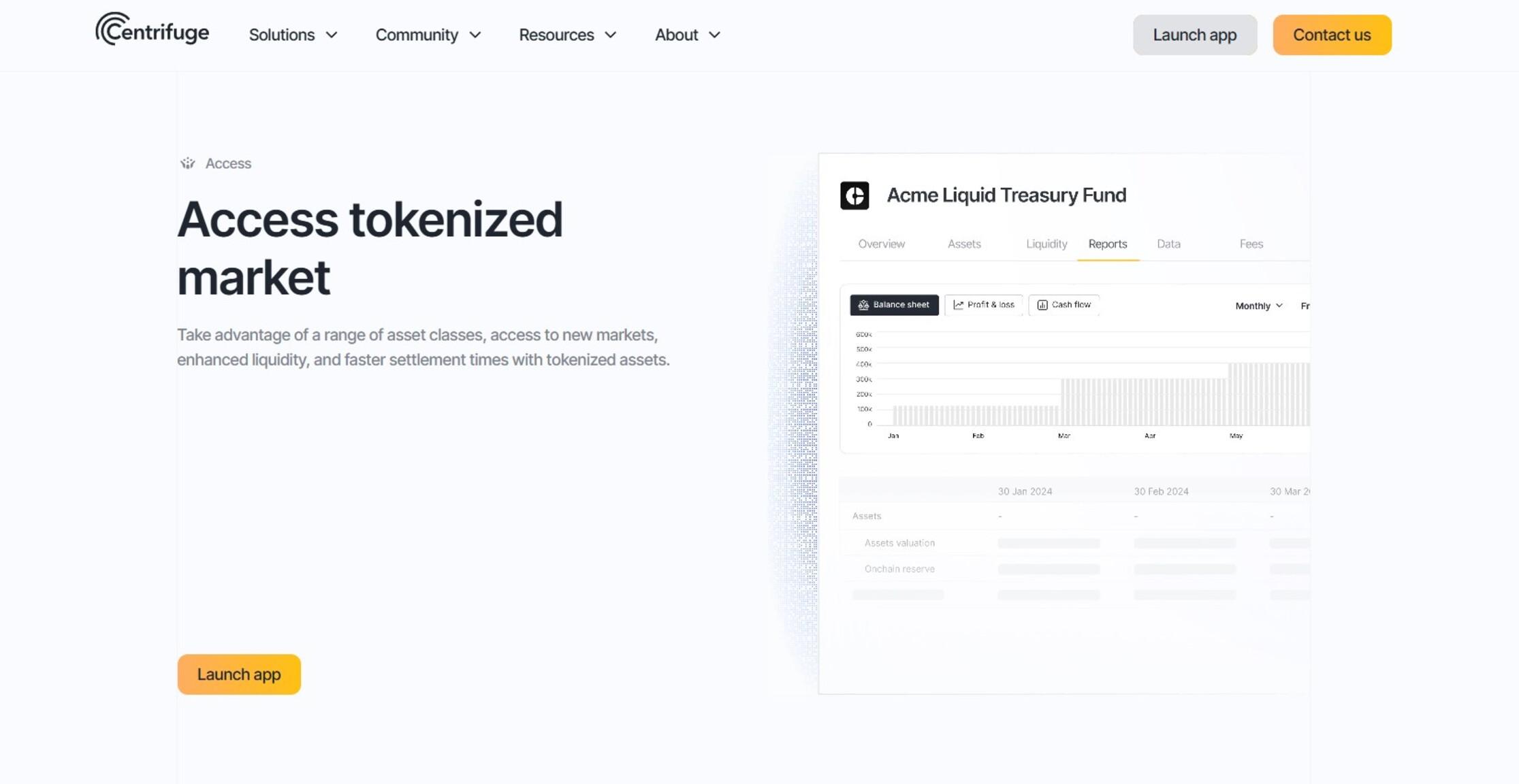
Centrifuge Prime is the whitelabel platform for institutions, automating end-to-end tokenization across chains like Ethereum and Base with built-in compliance tools for scalable RWA issuance. It acts as a marketplace and a decentralized investment application where asset managers, DAOs, and even funds can research asset originators, evaluate deals, and allocate capital to curated asset pools.
With Centrifuge Prime:
- Institutions can access the same financing opportunities typically reserved for private credit markets
- Capital can move from crypto markets into real-world lending
- Users can evaluate both risk and both its authenticity and performance of underlying assets
It’s also part of how Centrifuge bridges the gap between on-chain capital and off-chain demand, creating a more structured, transparent alternative to traditional credit markets.
What Assets Can Be Tokenized on Centrifuge?
Centrifuge supports a range of tangible assets and financial instruments that can be verified and structured for on-chain financing. Supported assets include invoice receivables and trade finance, real estate equity/loans, revenue-based financing contracts, inventory/supply chain assets, mortgages, royalties, credit portfolios, tokenized funds (like treasuries), and even experimental on-chain equity.
What Is the CFG Token?
CFG is the native utility and governance token of the Centrifuge protocol, powering its decentralized operations for real-world asset (RWA) tokenization.
CFG Tokenomics & Supply
With a total supply of 691,800,000 tokens as of January 2026, the token underwent a V3 migration in March 2025 that consolidated prior versions into an Ethereum-native ERC-20. Staking rewards flow from protocol fees and pool income, with linear vesting for ecosystem incentives running through April 2029.
Why Does CFG Have Value?
Beyond governance, the token derives value from securing the network via staking, paying transaction fees to validators and node operators, and enabling on-chain governance where holders vote on upgrades, treasury use, and parameters like fee burns.
CFG Use Cases
- Governance: Propose and vote on protocol changes, runtime upgrades, and economic policies.
- Staking and security: Investors can lock CFG for rewards, network validation, and collateral against misbehavior.
- Fees: Pay for transactions, NFT minting in pools like Tinlake, and platform usage.
- Bridging: Transfer as ERC-20 across chains like Ethereum for DeFi integration.
CFG on Binance (Earn, Margin & Futures)
Listed on Binance, CFG gives traders access to Earn products for staking rewards, margin trading for leveraged positions, and futures for perpetual contracts with up to 50x leverage.
However, like most mid-cap tokens, CFG can be volatile, so while access is there, it’s not as deep as top-tier assets. If you’re investing, ensure you understand the risk and invest only what you’re willing to lose.
Is CFG a Good Investment?
CFG’s investment case hinges on three things: your risk tolerance, your timing, and your conviction in the RWA market. After its Binance listing, CFG surged 60% to around $0.14–$0.15, with volumes topping $178M. If the RWA market grows toward $35–45B, some analysts project CFG reaching $0.20–$0.45.
The risks are real, though. Annual inflation sits at 3%, and supply is expanding toward 692M tokens. Downside forecasts put CFG as low as $0.07–$0.15. Regulatory pressure on off-chain assets and borrower defaults in asset pools add further uncertainty. Volatility is part of the deal.
The Future of Centrifuge
Centrifuge’s future depends on the growth of the real-world assets market, projected to reach $35-45B as traditional finance explores tokenized real-world assets. The protocol is positioned as core infrastructure, enabling asset originators to access liquidity and investors to provide capital through asset pools.
Upcoming milestones include expanding Centrifuge Prime, improving tools to research asset originators, enhancing network security, and rolling out protocol upgrades. Success is heavily tied to adoption, pool performance, and regulatory clarity, which will determine whether Centrifuge captures a meaningful share of the RWA-DeFi bridge.
Conclusion
Centrifuge (CFG) is carving out a unique space by bridging traditional finance and decentralized finance through tokenized real-world assets. It gives asset originators faster access to capital while offering investors a stable yield from structured asset pools.
The protocol’s future depends on RWA adoption, institutional participation, and the successful execution of Centrifuge Prime and protocol upgrades. For traders and investors, CFG is currently a high-risk, high-reward opportunity tied not just to speculation but to the real-world growth of finance on-chain.
FAQs
Yes, centrifuge CFG is listed on Binance, where it’s available for spot trading, margin, and futures products. The listing has helped increase liquidity and exposure in crypto markets.
CFG is the native token of the Centrifuge Chain. It’s used to pay transaction fees, participate in Centrifuge’s governance, stake for network security, and support protocol operations, such as structuring asset pools.
Not exactly. Centrifuge is the overall decentralized asset financing protocol, while Centrifuge Prime is the institutional layer, an open marketplace and investment dApp for researching asset originators and connecting investors with high-quality real-world assets.
Analysts project CFG could trade between $0.20-$0.45 if the real-world assets market grows as expected and adoption scales. Risks like inflation, supply growth to 692M tokens, regulatory hurdles, and market volatility could limit it to $0.07-$0.15 in a bearish scenario.